
Visual Communication Cards for Non Verbal Kids AAC Guide
⚠️ Medical Disclaimer: The information on this page is for educational purposes only and is not a substitute for professional medical advice, diagnosis, or treatment. Supplements are not intended to diagnose, treat, cure, or prevent any disease. Always consult a qualified Speech-Language Pathologist (SLP), pediatrician, or clinician before starting any supplement — especially for children.
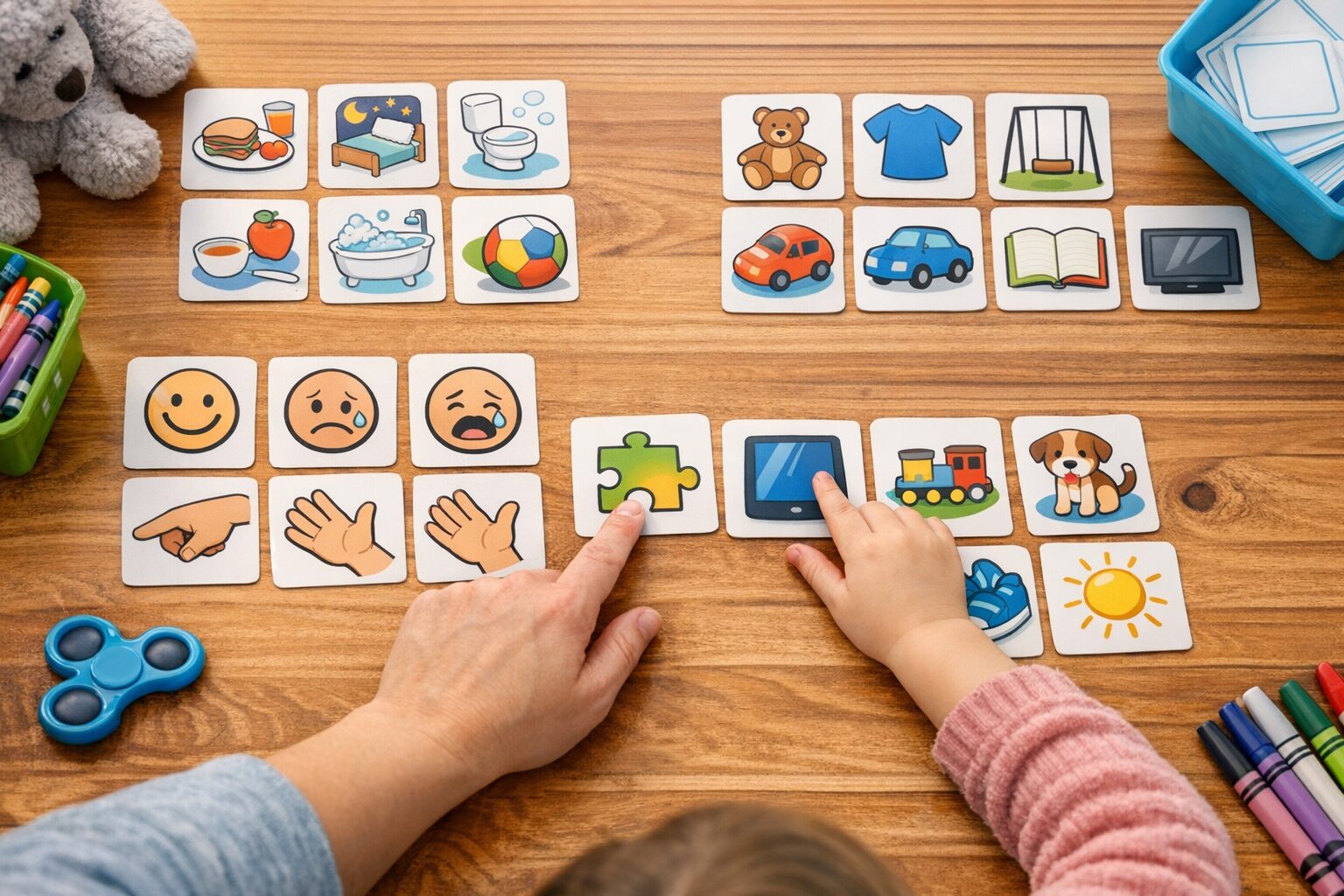
When your child can’t yet rely on spoken words, every moment can feel like a guessing game. You know your child has ideas, needs, and a personality ready to shine—there just isn’t an easy way to share them yet. Visual communication cards AAC can bridge that gap. With simple, meaningful pictures your child can point to, hand you, or arrange in a strip, you suddenly have a reliable way to ask, request, comment, and connect. In 2026, families have more approachable, affordable options than ever. This guide shares clear, parent-tested picks and practical tips to help you start strong and keep growing.

Best Products for Visual Communication Cards AAC
| Product | Best For | Why It Helps | Link |
|---|---|---|---|
| Picture Communication Cards | Starting AAC at home | Simple, high-contrast images make requesting and daily routines easier. | View on Amazon |
| PECS Communication Cards | Structured picture exchange | Standardized visuals support clear requesting and sentence strips. | View on Amazon |
| Communication Board | Classrooms and travel | Durable board with core words gives quick access in any setting. | View on Amazon |
| First Words Flashcards | Building early vocabulary | Bright, familiar pictures boost naming, matching, and categorizing. | View on Amazon |
| Emotion Cards Autism | Feelings and social language | Concrete faces and scenarios help label emotions and practice scripts. | View on Amazon |
Related Guides You Might Find Helpful for Visual Communication Cards
Picture Communication Cards (Starter Set) for Visual Communication Cards
Picture communication cards are a practical entry point for families beginning AAC. They are straightforward to teach, easy to carry, and flexible enough for home, school, and therapy. With clear images for food, toys, places, and actions, you can model choices and build short sentence strips like “I want + cracker.” Moreover, you can pre-teach cards during play, then use them during daily routines, which helps children generalize skills.
Pair this pick with our parent-friendly overview of Picture Communication Cards and quick vocabulary practice from First Words Board Books & Cards. Additionally, if your child is easily overwhelmed in noisy spaces, noise-reducing headphones can help them focus on communication.
Pros for Visual Communication Cards
- Clear, high-contrast images that are easy to scan
- Flexible for requesting, labeling, and routines
- Works with Velcro binders, key rings, or lanyards
- Budget-friendly entry to visual communication cards AAC
Cons for Visual Communication Cards
- Cards can bend or get lost without a system
- May need laminating for heavy use
- Limited core words in some starter sets
Best For Visual Communication Cards
- Families new to AAC who want quick wins in daily routines
- Early learners who benefit from concrete visuals
Picture Communication Cards → Check price on Amazon
PECS Communication Cards (Core + Fringe) for Visual Communication Cards
PECS communication cards support the well-known Picture Exchange Communication System approach that many schools and clinics use. While you do not need to follow every stage of PECS to benefit, these standardized visuals and sentence starters (“I want,” “I see,” “I feel”) make teaching requests and short phrases consistent across caregivers. Consequently, children learn to exchange a card to communicate a specific need, which can reduce frustration during meals, transitions, or therapy tasks.
For structure, combine with a simple card binder setup and a daily choice board. Furthermore, you can reinforce articulation placements during speech practice with the Articulation Mirror and breath control using our playful Bubble Set.
Pros for Visual Communication Cards
- Standardized icons and sentence starters for clear routines
- Compatible with PECS-style binders and Velcro
- Supports requesting, commenting, and question forms
- Easy to share across home and school teams
Cons for Visual Communication Cards
- Requires modeling and consistency to maintain progress
- Some sets are large and need organization time
Best For Visual Communication Cards
- Families and classrooms using PECS methods
- Children ready for sentence strips like “I want + item”
PECS Communication Cards → Check price on Amazon
Communication Board (Durable, Portable) for Visual Communication Cards
A communication board is a single, sturdy board with essential core words (go, stop, more, help, like) plus a few high-interest fringe words (favorite foods, toys, places). Because the words stay in the same place, your child can develop motor memory, which speeds up communication. Additionally, a board is quick to use during transitions, in the car, at the playground, and on field trips when loose cards would be cumbersome.
For smoother outings, combine a board with a small set of portable visual cards and a calming support such as a chew necklace if your child seeks oral input. Moreover, in louder environments, noise-reducing headphones can help your child stay regulated and available for communication.
Pros for Visual Communication Cards
- Always-available core words for everyday phrases
- Durable and easy to clean
- Great for travel, playgrounds, and the car
- Supports modeling aided language input
Cons for Visual Communication Cards
- Less customizable than individual cards
- Limited number of fringe words
Best For
- On-the-go communication and school inclusion
- Children who benefit from stable word locations
Communication Board → Check price on Amazon
First Words Flashcards (Vocabulary Builder)
First words flashcards are an engaging way to expand nouns, actions, and simple descriptors. Because pictures are bright and familiar, children can match, label, sort, and play memory games that build understanding and expressive language. Additionally, these cards double as visual supports for play scripts, like “feed the baby,” “wash the car,” or “make a snack,” which naturally creates opportunities to request and comment.
For extra practice, pair them with our curated First Words Board Books & Cards and practical play kits like pretend food or a pretend play set. Furthermore, you can find weekly at-home activity ideas on our Blog.
Pros
- High-interest pictures that invite naming and sorting
- Useful for matching, categories, and simple “wh” questions
- Easy to weave into story time and play
- Budget-friendly addition to visual communication cards AAC
Cons
- Some sets have inconsistent image styles
- Not laminated; benefits from sleeves or laminating
Best For
- Building early vocabulary and comprehension
- Play-based learning with toddlers and preschoolers
First Words Flashcards → Check price on Amazon Read more: First Words Speech Cards Building Early Vocabulary Guide
Emotion Cards for Autism (Feelings & Pragmatics)
Emotion cards help children connect facial expressions, body language, and contexts to feeling words. Because emotions are abstract, concrete visuals and simple scripts (“I feel sad. I need a hug.”) can make social language more approachable. Moreover, you can rehearse coping options to use later, such as “I need help,” “Break please,” or “Headphones please.” These cards reinforce both regulation and communication, which often go hand in hand.
For sensory supports that make social practice more successful, consider adding a Chew Necklace for oral seekers or a quiet corner with Noise-Reducing Headphones. Additionally, families exploring broader supports sometimes read our overview of Dr. Frye’s folate research or the book The Folate Fix by Dr. Frye to learn more; always pair reading with conversations with your child’s care team.
Pros
- Clear faces and real-life scenarios
- Prompts for coping and self-advocacy scripts
- Useful for small groups and social stories
Cons
- Requires adult modeling to generalize
- Abstract concepts may need repetition and role-play
Best For
- Children building feelings vocabulary and self-advocacy
- Social-emotional learning at home and school
Emotion Cards Autism → Check price on Amazon
How to Choose the Right Visual Communication Cards

Match your child’s stage, not just age
Start with visuals that fit how your child currently communicates. If they are just beginning, choose simple requesting cards (eat, drink, help, more) and a few favorite items. As skills grow, add core words (go, stop, want, like) and actions (open, play, read). Consequently, your child will experience success early and remain motivated.
Core words in visual communication cards AAC
Core words appear across contexts and drive most daily language. Therefore, look for sets that include highly reusable words and consistent placement for aided language modeling. Communication boards shine here, since location stays stable over time.
Fringe words that matter to your child
Select fringe vocabulary based on your child’s real life: favorite snacks, people, places, and routines. Additionally, keep a short “high-interest” ring on hand for quick wins during play and meals.
Durability, size, and organization
Laminated or thick cards last longer, especially if your child loves water play or the sandbox. Smaller cards travel well, while larger cards may be easier to grasp. Moreover, plan a system: Velcro binder, lanyard, or a single communication board for outings. For starters, see our simple guide to organizing Picture Communication Cards.
Portability and environments
Home, school, therapy, and community settings all have different needs. Therefore, choose a system your child can use everywhere. A communication board plus a small set of cards often covers most situations.
Integration with AAC apps and devices
Consistency helps. If you use an AAC app like Proloquo2Go or TouchChat, align your printed visuals to similar icons and layouts. Furthermore, a shared vocabulary across paper and digital helps your child switch contexts smoothly.
Sensory needs and visual clarity
High-contrast images, simple backgrounds, and minimal visual clutter reduce cognitive load. Additionally, some children benefit from sensory supports during learning; tools like a Chew Necklace or Noise-Reducing Headphones can support regulation, which often strengthens communication availability.
Budget and printing options
Starter sets are affordable, and printable resources from educators can fill gaps. For custom cards, explore Teachers Pay Teachers Resources. Moreover, protect your investment with laminating or card sleeves so your visuals last.
Common Mistakes to Avoid
Waiting for speech before starting visual communication cards AAC
Visuals support language learning; they do not replace it. Therefore, you can start with pictures now while continuing to model spoken words. Many children benefit from both.
Only using nouns and skipping core words
Nouns are motivating, but core words (go, stop, more, help, want) build sentences. Additionally, core words appear across activities, which means more practice opportunities.
Not modeling enough
Adults should point to or hand the same cards they want the child to use. Consequently, consistent modeling teaches the purpose of each card and shows that communication works.
Overloading the board or binder
Too many cards at once can be overwhelming. Start small, then add gradually. Furthermore, rotate fringe vocabulary based on the day’s activities.
Skipping organization and routines
Loose cards disappear quickly. Therefore, pick a binder, ring, or board and decide when and where to use it: meals, bath, car rides, playground. Consistency builds habits.
Ignoring sensory context
If a child is dysregulated, communication gets harder. Additionally, consider supports like a quiet corner, predictable routines, or Noise-Reducing Headphones to help your child be ready to communicate.
FAQ

What age can we start with visual communication cards AAC?
You can start as soon as your child is showing preferences or choices, even in toddler years. Begin with motivating items and simple core words, then expand gradually as attention and interest build.
How many cards should I introduce at first?
Start with 4 to 8 high-impact cards (more, help, eat, drink, preferred snack, favorite toy). Additionally, add one or two new cards each week, and remove rarely used ones to keep the set meaningful.
Do visual cards stop my child from talking?
No. Visuals are a support for language learning, not a replacement. Moreover, many children progress in understanding and engagement when they have a reliable way to communicate, which often encourages more sound and word attempts.
Should we choose a communication board or loose cards?
Both are useful. Boards provide quick access to stable core words, while cards allow you to customize and swap fringe vocabulary. Consequently, many families use a board plus a small ring of favorites.
How do we keep cards clean and organized?
Lamination or plastic sleeves help. Additionally, use a binder with Velcro, key rings for high-interest items, and a labeled pouch in your bag for outings.
Can we align paper visuals with an AAC app?
Yes. Match icons and word locations to your app, such as Proloquo2Go or TouchChat, so your child recognizes patterns across tools. Furthermore, keep the same core words available in both.
Where can I learn more AAC strategies?
Explore our step-by-step guides on the Blog, and learn about our mission and review standards on the About page. Additionally, you can browse evidence-informed reading like Proloquo2Go resources and parent-friendly books listed on our site.
Final Verdict
Visual communication cards AAC give kids a dependable way to express needs, share ideas, and participate throughout the day. For most families, a simple starter like Picture Communication Cards plus a sturdy Communication Board covers the essentials, while PECS Communication Cards add structure for sentence strips and First Words Flashcards expand vocabulary during play. Emotion visuals can round out social language. In 2026, you can begin small, build routines, and grow your system alongside your child. Most importantly, keep modeling, keep it portable, and keep it joyful—communication is connection.
🔗 Quick Links to Our Top Picks
Our Promise: We research and compare so your child can get the support they deserve.
Explore More in AAC & Communication Tools
Browse all 2 parent guides, product reviews and research summaries in this category.
Browse All Articles →